Wednesday, March 19, 2014

Here are some photos from our class trip to New York City. We had a great exhausting time.

Description of the Tenement Museum building


The FOUR privvies for 20 families

the group in Chinatown

The group at the Flatiron, close to our hotel
What passes for art these days...

Wednesday, March 12, 2014

Age of Innocence: Appendix E (3 & 4)


Both of these pieces look at different aspects of marriage during the time period.  Emma Goldman and Edith Wharton have similar views on American marriage and its faults.  In Wharton’s article, she compares American women to Frenchwomen.  Their views tie in with what we’ve seen within The Age of Innocence. 


“Marriage and Love”

Emma Goldman discusses her beliefs on marriage and love.  Marriage at this time was an economic arrangement based on capitalism since money was one of the most important things.  The women paid for marriage with their self-respect, privacy, and their name.  Goldman compared women to a parasite because they became completely dependent on their husbands.  For men, their only stress was economic stress, while the women took care of their home and family.  She discusses how marriage protected children, yet there were thousands of homeless and orphaned children.  In addition, she talks about how marriage and love had nothing to do with one another.  With that, she believes that love is stronger than marriage and that if love continues in married life, it is regardless of marriage.  She believes that love rarely ever comes from being married first.  Also, she talks about how a young girl’s main goal was to get married when she grew up.  “From infancy, almost, the average girl is told that marriage is her ultimate goal; therefore her training and education must be directed towards that end” (Pg. 383). 


“The New Frenchwoman”

Edith Wharton introduces her idea of the Frenchwoman and how the new Frenchwoman is only new because American women were not familiar with them.  The Frenchwoman is seen as more grown-up, not only because of her dress, ability to cook, and femininity, but because of her relationship with men.  For example, women are book-keepers or clerks in their husband’s small business.  She also contrasts the Frenchwoman with the American woman.  The Frenchwoman would rather be happy than have money, while American women want money.  Although American women legally have more freedom, Frenchwomen live more freely.  This is due to the fact that women in America feel trapped in their marriage since it is simply an economic arrangement, while French women married for love and are altogether happier.  Frenchwomen have more of an impact in their French society than American women do in their lives. 


Comparison:

The average French woman was more advanced because they had a different sense of marriage.   In America, women had more legal rights, but their marriage held them back from exercising them.  Their husbands had the ultimate control.  In France where women did not marry solely for monetary reasons, they had more freedom because they were equal partners with their husbands.  American women are trapped at home where they are not valued but French women can have an impact in society.  The differences between French women and American women can also be seen in The Age of Innocence.  May is like the typical American women; she is used to the husband being the dominant person in the relationship, and she is educated on the rules of society and housekeeping.  Ellen is more like the typical French woman; she knows more about art and culture than the rules of society and she treats men more like equals. 
 

Discussion Questions:

1.     Goldman states, “Marriage and love have nothing in common; they are as far apart as the poles; are, in fact, antagonistic to each other.” Compare Goldman’s view of marriage with marriage today? Does her view of marriage and love fit with what we read in The Age of Innocence? If so in what ways?

2.     Who do you think Goldman intended her audience to be? What do you think their response was?

3.     In Goldman’s article, we once again see a difference in the standards for men and women, this time involving marriage. What are some ways marriages impacted women differently than men? How is this illustrated in The Age of Innocence?

4.     Which do you think is more successful: marriage for love or marriage for money? Reference the statistics Goldman gives in her article on marriage (pg. 182).

5.     Wharton brings up the idea of French women being more grown up than their American counterparts. What does she mean by “grown-up”? In what ways does she illustrate this in her article?

6.     In Wharton’s article, what do you find to be the most interesting difference she states between the Frenchwoman and the American woman?

7.     Do you think that differences in marriage practices in societies affect the treatment of women in those societies? Consider both articles.

8.     How do both articles relate? Is perhaps the lack of love in American marriages that Goldman asserts a cause for the differences between women in the different societies that Wharton highlighted?


Wednesday, February 26, 2014

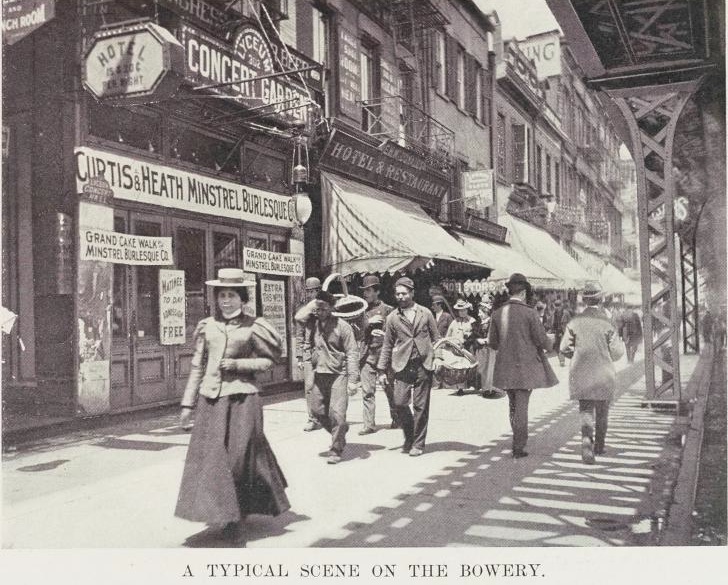
Shops, Saloons, Concert Halls


THE BOWERY:

Julian Ralph, a newspaper author, shares his insights of the Bowery. He believes how the Bowery is perceived (lively and genuine, criminal-filled, abandoned and disreputable, etc.) by New Yorkers depends on their position in society. The Bowery was once a place of exchange for New York drovers and butchers. A cattle-market was replaced by a theater and the Bowery had its foundation of entertainment. The “Bowery boy” was a name coined for a man or boy working during the day and looking for women or being a volunteer firefighter by night. This type sang and danced well, and often visited the theater. Bowery boys sang and danced well, and dressed suavely, but evolved into fist-fighting, drinking, and gambling patriots. (In Maggie, Pete was a well-dressed gentlemen who ran a bar during the day and looked for entertaining women by night.) Later, the Bowery became a crowded and noisy street of shops (grocers, bakers, firemen’s goods), lodging-houses (many of which were exclusively for men), and museums. At night, the museums were bright with lights and added to the Bowery’s appeal. Fashion and style in the Bowery surpassed any other style, when compared to the rest of New York. Ralph notes that there are 82 places that sell alcohol, including 4 music-halls, restaurants, oyster-houses, wine-houses, theaters, and variety-halls. Theaters show plays and orchestras, and are surrounded by newsboys and street Arabs. Before the theaters open, young boys crowd the doors and burst in for popcorn and cheap entertainment. Ralph also calculates the price of living, too; “A man may eat and lodge in the Bowery with a good bed and three meals a day for $4.90 a week, and with a fifteen-cent bed and eight-cent dishes for $2.73 a week” (155). The criminals found in the Bowery are malnourished, secluded, and poorly dressed. “…they are rather like human rats than men and women” (157).

THE BOWERY AT NIGHT: 

“The Bowery at Night” was written by David Graham Philips. Philips was not a native New Yorker and moved there to work as a journalist. This section was originally published a short time after Philips arrived on the scene and it expresses his disappointment in the Bowery, as well as its darker side. In the books he read when he was a young boy “the Bowery was a wonderful place – fascinating, full of romance, yet terrible and most dangerous.” The people around the Bowery were diverse, witty and intelligent. He describes that this idea that the Bowery was such as fascinating and entertaining place, was so wide spread and commonly believed, that tourists who visited and actually saw the Bowery were deceived. “Confident of finding their ideal realized, they are not disappointed, and returning home, tell of the wonders they have seen.” However, on Philips visit the first sensation he feels is disappointment, for he discovers that the Bowery is nothing but hollow and empty, even when filled with people. It is because of these people and the setting. They are described as the lower class, who live in cramped and filthy boarding houses. These people are from the same cloth as Maggie and her family. “The crowd is looking for pleasure, for relief from the squalor at home, from toil at shop and factory.” These people came here to try and find a distraction from their current situation. But it does them no good for Philips writes that real laughter is as rare as sunshine. If you actually start to laugh, something else that exposes the pitiful nature of the surroundings quickly kills it. “The people are clearly on the edge of life, fighting anxiously, harassedly, for a foothold, and seemingly never quite gaining it.” He didn’t need to know where these people lived to be able to identify the conditions they came from. It was evident in their clothing, their looks, and the way that they carried themselves. “The tragedy is too near the surface, peering from rents in garments or blanching under the paint of cheeks. In this pleasure, you can have no part, any more than you could live in the smells and sounds and sights of a rickety towering tenement.”


WHERE 'DE GANG HEARS THE BAND PLAY:

This section is actually written by Stephen Crane himself. It involves some very familiar characters.... Maggie and Jimmie! The section starts off with Maggie informing Jimmie that she is going to see a band that night and insisting that Jimmie returns the watch to her. Jimmie is very difficult about this. Maggie enjoys the pleasant music with her "lady friend" The star-spangled banner played and the room feels the patriotism. It is also important to note out the large number of people of German descent at this concert. Here is where this section really gets it's title. The watch that Jimmy refused to give back to Maggie he went and pawned. This money was then used to buy beer and head with the concert hall. They sit where they can hear and enjoy the music. The "gang" was told to move along by the cops. So they did.... Just around the corner so that they could continue to listen to the music.

THE BEER GARDENS:

James D. McCabe, author of this section, describes the German side of New York, specifically the beer-gardens.  Here, men find merriment by drinking, smoking, listening to music, and enjoying each other’s company.  The main beer-garden in the Bowery was called the Atlantic Garden, located near the Old Bowery Theatre.  The Atlantic Garden was huge, having a gallery just for eating, a gallery for only drinking beer, and even a shooting hall gallery.  There was also an orchestration or music box that would play music to the guests.  McCabe goes on to say that only beer and some light Rhine wines are strictly served and that no guest is ever drunk.  “They come here with their families, spend a social, pleasant evening, meet their friends, hear the news, enjoy the music and the beer, and go home refreshed and happy.” (172) The opposite side of the Atlantic Garden was the Central Park Garden, which was a more American take on the beer-garden.  One has to pay to enter this garden, unlike the Atlantic Garden.  Nightly concerts are held at the Central Park Garden during the summer, which draws music lovers to come to New York simply to hear the famous orchestra.  Many celebrities would be seen at the Central Park Garden as well.  Unlike the Atlantic, all kinds of alcoholic beverages were sold there, not just beer and wine.  Some strangers called this garden “Thomas’s Garden,” a place of enjoyment and merriment, especially during the summer. 

Picture of the Atlantic Garden:

"THE SALOON IN SOCIETY":

Written by George Parsons, worked for New York Tribune. The first main point of this section talks about the effects that saloons had on society. However, these effects of the saloon are not positive. Saloons are always in areas of the lower levels of social class. People who already have problems with salaries and money only make themselves worse off by going to the saloons and wasting their money. The saloons are seen by these men as a way to try to escape and forget their sorrows. By doing this they only make the problems worse with their drinking. This causes tension among family and friends. The men fall into a vicious cycle, revolving around drinking and poor health. This leads to an increase in crime as well. The alcohol abuse has many negative consequences. All of this has led to increased hospital and police activity overall. "He is poorer, in worse health, less able to confront difficulties, on the morrow. But one tendency in him is strengthened, and that is the tendency to repeat the debauch." (176). Many of these concepts of saloons are seen throughout Maggie. Mainly in the way Maggie's father acts in the beginning (41), and Pete and Jimmie's antics in the bar (71).

"May Gawd forgive dat girl," "I bringed 'er up deh way a dauter aughta be bringed up an' dis is how she served me! She went teh deh devil deh first chance she got! May Gaw forgive her."

"TEMPTING THE POOR WOMEN: THEY BUY BEER AND HAVE IT CHARGED AS POTATOES":

In Maggie, A Girl of the Streets, one of the reasons that Maggie’s home life was so terrible was because both her parents had a drinking problem.  Maggie’s mother was often drunk, but she denies it to Maggie’s father like most wives would at the time.  Female alcoholism was a big problem during this time period.  Most married women at the time did not have their own personal funds.  However, many women would use their husband’s income to buy alcohol for themselves.  The problem for women was that most husbands would not allow their wives to use their money to buy themselves alcohol, but the grocers found ways around this to allow women to buy alcohol.  Bar owners started disguising their store fronts as regular grocery stores so that women could buy liquor and have it charged as potatoes or other food so that their husband would not know that they were buying alcohol for themselves.  Women could go through the grocery store front and buy groceries as well as alcohol so that they would not feel ashamed to be buying alcohol.  They could also have their kids go to the store and have alcohol charged as groceries as well.  By charging the food as groceries, the husband would not know his wife and children were buying alcohol when he went to pay the food bill.  

METROPOLITAN LIFE UNVEILED; OR THE MYSTERIES AND MISERIES OF AMERICA'S GREAT CITIES:

This section also does not have many nice things to say about the Bowery. This section jumps all over the place, because J.W. Buel recalls his experience walking through the Bowery. He touches upon the sights, smells, and sounds, including the bands and people on the streets. Throughout the night, he touches on the drunkenness of the people he sees on the streets. One point that he makes very clear is that the women dress very promiscuously by exhibiting themselves as a "human menagerie" in a way to intrigue and entice the men. Buel talks about how these boys are fighting on the streets. This relates directly to the aggressive nature of the boys in Maggie... Especially Jimmie.
Harry Hill, specifically his theater, is briefly presented in the section, as well.  Harry Hill was a professional prize fighter who was aware of the tricks and trade on the streets of New York.  Buel discusses that his theater hall was used to plot "...hundreds of robberies which occur[ed] within a stone's throw of, and upon men just leaving, the theatre." (191)

DISCUSSION QUESTIONS:

1. The saloons section talks about the major part of the culture that saloons had in these poor areas during this time period. Are these poor conditions more a result of poor human intuition? Or the fault of the saloons trying to take advantage of these people?

2. Stephen Crane's excerpt really focuses on the sounds of New York. Jimmie will go through all this trouble to listen to the music with the gang. Why do you think music is worth this trouble to the boys of this neighborhood?

3. In today’s society, have beer-gardens been replaced with your run-of-the-mill bar?  Or do we see instances of beer-gardens today in America?

4. How similar is the Bowery to the saloons, in relation to people wanting to escape their reality? 

5. This section states that women were more ashamed to go buy alcohol than men were.  Why do you think there were different standards for men and women when it came to drinking?  Do you feel sorry for Maggie’s mom at all? 

6. During the day, many people like Pete lived hard-working lives integrated with all sorts of people they dealt with, like Jimmie. During the night, they went out for drinks and entertainment in high-class restaurants and theaters where they left their worries and hardships behind. If someone living in the Bowery worked such a hard life during the day, how do you think they could afford expensive drinks, cigars, and entertainment?

Tenement Life


Background: Tenement buildings were four or five stories high and there were 4 tenement buildings to a block, which was 700 ft x 200 ft.  There were typically 1, 736 rooms to a tenement.  At the time, there were 33,000 tenements in New York City with 2,076 people in 1,736 rooms which contained 460 families.  These rooms were about the size of a small closet and were overly crowded.  Due to this overcrowding, New York had a population density of 290,000 people per square mile compared to London’s population density of 170,000.  The rooms were expensive, they were $2 a week for a small basement and $6 a week for 2 rooms in a tenement.  It was a source of investment for higher classes. 
 
 
Problems: There were many problems with the tenements.  They were overcrowded with multiple families living in one room.  As well, the living conditions were very poor; there was no protection from the hot and cold.  Fire was their only source of heat.  Generally there was one common sink and outdoor bathrooms for the whole tenement, leading to a lack of sanitation.  There was a higher death rate among the tenements compared to other living arrangements.  In addition, the tenants were taken advantage of by the landlords who made 20% off of the tenants when they should have only made 6%; 6% would have been more beneficial to both the landlords and the tenants.  Lastly, it was a poor environment for children to grow up in.  There was a lack of privacy, and abundance of domestic violence and alcoholism. 
 
Solutions: Many solutions were proposed to solve the tenement’s problems. To fight the heat, the tenants would sleep on the roof of the tenement houses or buy ice if they could afford it. St. John’s Guild was a charity organization that helped to relieve the heat. The Fresh Air Fund contributed by sending children to the country for the summer. Some suggestions that were offered were to give free ice and to tear down the tenements and build parks in their place. To fight the general misery, organizations such as the City Mission and Children’s Aid Society helped the people living in the tenements. Some suggestions that were offered were to teach the people to care about their families and sanitary practices. Giving away free fruit and medical assistance were also suggested.  The rich were made more aware of the plight of the poor. Another problem that activists tried to fix was how unaccountable the landlords were, so a law was passed that required that the landlord’s name be displayed in the rooms of the tenements. A proposed solution to this problem was that if the landlord only took a six percent profit then quality rooms could be offered for only $1.50 a week. To fix the general disorder in the tenements, it was suggested that each one employ a housekeeper or janitor.
 Link to Tenement Museum of New York

"Life in the New York Tenement-Houses"
"Life in the New York Tenement-Houses" first appeared in Scribner's Monthly.  William T. Elsing was a clergyman from the Dewitt Memorial Church who devoted 9 years to help the poor in the East Side of New York City.  He gives a more truthful account of what he has seen and heard, rather than cramming in all of the thrilling and startling facts about tenement-houses that other articles tend to do.  He talks about how living in a tenement-house is not synonymous with living in the slums even though most people think it is.  An ordinary tenement house consisted of 5 stories of different types of homes, varying in amount of rooms and pricing, and a basement.  Four families typically occupied a dark and dirty floor that had sinks in the halls.  Tenement houses had a landlord, an agent, and a housekeeper.  Some families sometimes have to go half clothed and live on the cheapest food in order to provide rent, but not all of the people are thriftless; 700 out of every 1000 depositors in one of the banks on the Bowery live in tenement-houses.  Sometimes people start out poor, being at a low point in their life, but then are eventually able to get out of the tenement-houses.  Elsing tells two stories that depicted the different people who lived in tenement-houses.  One German woman with a daughter couldn't pay for rent, and ended up with her furniture on the street, and after Elsing talked with her neighbors and learning she had good character, he rented her two small rooms.  Two months later when she couldn't find a job, and Elsing having heard of a job in Orange, New Jersey, arranged for the woman to get the job and paid for her fare.  On the other hand, a Polish man tried to make money from the author by playing on the sympathies of poor people. 
Discussion Questions
1) How do Elsing's accounts of the tenement-houses compare and contrast with Crane's depictions in Maggie: A Girl of the Streets? 
2) Were the solutions realistic?  What do you think about them?  Do you have any other ideas for solutions to tenement-house problems?
3) Refer to the following two quotes:
"The girl, Maggie, blossomed in a mud puddle"- Crane
"Some of the noblest young men I have ever known have worthless, drunken parents.  Some of the most beautiful flowers grow in mud-ponds, and some of the truest and best young women in our city come from homes devoid of good influences; but in all such cases uplifting outside help has moulded their characters."- Elsing
How likely do you think it is for someone to get out of the tenement-houses and make something of themselves?  Is Elsing's quote too optimistic, especially relating to Maggie's situation? 


Monday, February 24, 2014

The Painted Cohorts (263-301)


 Kaitlyn Frey, Tara Kennedy, Keith Russel, Zach Waltman and Mike Donovan

The Tale of Rose Haggerty:
Rose Haggerty, who was born in a Cherry Street tenement-house, refuses to fall in the wake of semi-starvation, dirt, and smells that she experiences daily. Her father, Dennis Haggerty, who unloaded ships and other odd jobs, has six children remaining (including Rose) out of twelve. Dennis and Norah, Roses parents, are both alcoholics. One night, Dennis tells Rose to take all the money in his pockets and keep the children straight. At seven years old, Rose is a responsible person, and does not wonder why her mother drinks. Their parents swear to give up alcohol, but never do. Rose learned to hide her clothes and things in an old shoemakers shop to keep them protected. Eventually, a fever killed Roses father, her brother Dennis, and left Norah paralyzed from spinal disease and unable to work.

Rose starts working at a bag-factory, soon earning $4 a week, but the old shoemaker helps pay for the first month’s rent, which is $6 a month, and occasionally takes care of the children. At 14 years old, Rose works 10 hours a day, then comes home to cook, clean, wash, and mend. Mrs. Moloney, a friend of the old shoemaker, teaches Rose how to manufacture shirts, and Rose takes work through her. Mrs. Moloney does not take advantage of Roses quality work, and Rose makes around $30 a month for 2 years while working 10-14 hours a day. Eventually, shirt prices drop, and are more closely scrutinized for flaws. Rose finds it harder to make a living as she performs various clothes manufacturing jobs, and can no longer stave off starvation or the cold. Refusing to give up her brothers and sisters after 20 years of hard work, Rose decides to try one more attempt at honest work. Bringing her work in to be inspected, she realizes that her needle “jumped”, and the foreman inspecting her only pays Rose $3.45 for the week.

Walking by the river in despair, a sailor grabs Rose by the arm and offers to pay her for sex. Even though it is dishonorable, Rose finally obliges so she can provide food and warmth for her siblings. The sailor even offered to marry Rose, but she said that no man would ever marry her after what she had done that night. Keeping her word to never marry, Rose officially becomes a prostitute, and is now able to provide for her family because of the steady work and decent wages she can earn. Rose concedes that she will probably not live long, but her siblings will have a better future because of the sacrifices that she had to make for them.

Reasons Women Became Prostitutes
Dr. William Sanger interviewed 2000 prostitutes on Blackwell’s Island, where he was the resident physician, in the 1850s.  He documented the reasons the girls gave for why they became prostitutes in the last section of his famous work, The History of Prostitution: Its Extent, Causes, and Effects throughout the World.  His research yielded these results which can also be found on page 267 of the Bedford Cultural Edition of Maggie: A Girl of the Streets:

Destitution was the cause of 26% of the girls resorting to prostitution, the largest percentage for any one reason.  Further questioning of the participants in the study revealed that they often “earn so small wages that a temporary cessation of their business, or being a short time out of a situation, is sufficient to reduce them to absolute distress” (270).  Sanger gave examples of girls who tried everything else before turning to prostitution and only did so when it was a matter of life and death.

25% of the girls became prostitutes because of Inclination.  While it was very taboo to report on at the time, Sanger acknowledged that some women “resort[ed] to prostitution in order to gratify the sexual passions” (267).  He went on to say that these “passions” were only awakened due to interactions with males, associations with prostitutes, intoxication, or some other outside source, ultimately dismissing the notion that any woman would naturally be inclined to be a prostitute. 

Ill-treatment by parents, relatives, or husbands was the main reason 164 of the women in the study became prostitutes.  Abuse was very likely associated with other causes in a lot of these cases, such as the desire to drink, violation, and seduction and abandonment.  For example, Maggie represents the demographic of prostitutes who were “seduced and abandoned.”  Her “ill treatment by parents” was a contributing factor that led to her descent into prostitution.

The beliefs that all women were naturally pure and even when they sinned it was out of weakness and not vice, gave rise to the notion that “seduction and abandonment” was the main cause of prostitution.  Sanger’s research says otherwise.  In fact, only 13% of the women interviewed gave it as their reason.

Drink, and the desire to drink was an interesting category in that it was closely tied to other reasons.  For example, women could have turned to alcohol as a way of dealing with the pain of “ill treatment” or “abandonment.”  Alcohol was also a big part of many girls’ lives after they had descended into the realm of prostitution.  Edward Crapsey observed, “If the unconsciousness of inebriety is ever a blessing , it is such in the case of these lost women, as it permits them for the time to forget what they are and must be always” (278).  

Effects on the Health of Prostitutes:
In addition to the information present in our readings, we decided to do some outside research on the lives of prostitutes once they entered the profession involving their health and means of birth control. No matter what reason a woman had for becoming a prostitute, sexually transmitted diseases were a serious concern. In The History of Prostitution: Its Extent, Causes, and Effects throughout the World, Dr. William Sanger discusses various diseases that resulted from being a prostitute. Out of 2,000 prostitutes that were treated in New York on Blackwell's Island, 59% reported no diseases, 8% had at least one episode of gonorrhea, 5% showed more than one attack, 20% experienced one attack of syphilis, while 7% experienced more than one attack, and 2% experienced both gonorrhea and syphilis. While these numbers may not be staggering, these are only statistics from one source of people being treated. Diseases between sexual partners were still being spread and a number of undiagnosed cases still remained. In order to receive treatments for diseases such as syphilis, prostitutes had to go to a hospital. This cost them money that they didn't have. The only way for them to receive free treatment was if they went to a prison, such as the cases cited involving Dr. Sanger. Chapter XXXVII on page 627 of The History of Prostitution: Its Extent, Causes, and Effects throughout the World discusses this predicament while suggesting other possible solutions (see link for chapter). Overall it is possible that these diseases lead to the degradation of prostitutes and lowered the class to which they belonged.

In order to prevent pregnancy it would make sense for prostitutes to have utilized some form of contraceptive. In 1861, The New York Times printed the first ever condom advertisement called “Dr. Power's French Preventatives”. Goodyear, the tire company, mass produced these condoms after learning about rubber vulcanization. Around this time females also used coco-butter and a chemical known as quinine as barrier methods. Once inserted into the vagina and melted, these substances created a thick fluid barrier that prevented fertilization. It is unknown whether prostitutes used these exact methods however, it would have been important for them to prevent pregnancy some how. More history on contraceptives can be found here: http://www.medicinae.org/e08

The Different Classes of Prostitutes and Ties to Maggie:
Crapsey discusses and goes into detail about the different levels of prostitutes that were present in the 1850s when Maggie was set. He starts with the lowest type, referred to as the “street-walker.” These women were often poorly dressed and described as having “no beauty in face or form,” and succumbing to sleeping in cellars. Crapsey utilizes interesting diction in addressing these women, referring to the as “creatures.” These are the women that seek out and ask every man that meets their gaze, showing their desperation and their low standing. The women of the middle level present themselves a tad better and were seen to have some form of past beauty. It was not unheard of for these women to have their own housing near their tramping ground, and they were also more likely to speak first and address a potential customer. Both the lowest and middle levels were seen the hour before midnight, signifying what grade of cohort they were. The highest class of prostitutes would retire by ten o’clock, which showed their standing, as they were not out with the lower class women of their class. These women were very elegantly dressed and were skilled at making men approach and talked around the obvious subject at hand. They lived in respectable houses and gave off an impression of a quiet, reputable life.

We see examples of these classes of prostitutes throughout Maggie. Crane describes how Maggie transitions from one class to another until she is simply a streetwalker, the lowest form of prostitution in 19th century New York. On page 87, Maggie is described as throwing “changing glances at men who passed her, giving smiling invitations.” This shows that Maggie was a member of one of the higher classes as she was not approaching the men and asking them, but inviting them with her stare and making them come to her. The chapter transitions to Maggie entering the poorer districts of New York and finding an old, drunk and greasy man as a customer. Another example is Nell, who is a prostitute of the highest class and has figured out the system behind her controversial lifestyle. She is described as being very elegant and well dressed, and talks to Pete about business in Buffalo, showing how well she understands how to operate in her line of work.  She is the only character in the novel whose dialogue is not unreadable, which shows that she is of a higher class than other characters, despite being a prostitute.

Doubled Standard
On page 283, Edward Crapsey points out the lack of punishment for the men that use these services in his article, “Prostitution”. He explains that if the men are never punished then they will always go back to the brothels, giving reason for women to enter the field. This idea of only punishing women can be seen not only with prostitution, but also on the topic of premarital sex. Pete publicly getting intoxicated and paying for the prostitutes company shows that it did not affect a man’s reputation to be associated with the working girls. Also, the men joke at Maggie how the have they do not have the money for her services that day, showing that they take prostitution light-heartily. As said before the double standard on premarital sex is more prevalent. The boldest example is Jimmy and his mother’s reaction they have when they figured the situation. They were not only disgusted at Maggie that they shunned her, but it took the sever action of death for them to forgive her. Jimmy even noted that he sleeps with multiple women, who could have a family just as Maggie did, but quickly disregarded it. Jimmy’s mother and his own disregard about his actions, unlike their feelings towards Maggie, show this double standards. It is a two way street.

Discussion Questions:
1.     What parallels, if any, do we see with the lives of Rose Haggerty and Maggie Johnson? Do their paths to prostitution both follow the path so popularly believed in this time? Which girl would say was in a worse situation?
2.     Reports show that New York had the most prostitutes of any American city during this time period. What kind of impression could this have had on people’s view of New York back then? Does it make you view New York as any different in the present day?
3.     The article on contraception through the ages discusses how birth control methods, such as condoms, were very expensive and not largely advertised until the 1860s, when prostitution was already well established with women of New York. Do you think that lower prices or more awareness would have led to fewer venereal diseases in these women?
4.      In the novel, we see examples of the classes of prostitutes explained later by Crapsey. Are there any other parts of the novel where prostitution is hinted at before Maggie officially becomes a streetwalker?
5.     The novel touches on inequalities between genders in regards to opinions of prostitution and the involvement of men and women. This is seen with Pete and Maggie; one of whom gets arrested for an altercation and receives no reprimand for premarital sex, the other kicked out of her house and forced into a desperate lifestyle that ends up ending her life. Do you think Pete got off easy, by being beat up, arrested, and almost losing his job or did he get off easy compared to Maggie?